
The Creator Spotlight is the Bird's Eye's monthly-ish feature on the artists, makers, and builders who call Quadra home. It's also a totally valid reason for your Editor to gallivant this fair island, chitty chatting with artists. Each installment features a different creator and a decidedly un-rigorous, deeply human conversation about art and life.
This page collects all eight installments, published between November 2025 and October 2026, along with our one-year look back, newest first. Each appears as it was published, with the artwork that ran alongside it.
Know a Quadra creator whose work deserves a closer look? Or is that person you? We'd love to hear from you: quadrabirdseye@gmail.com
A year ago this month, I sat down with Helen Lee on a rainy November afternoon and launched a new series in the Bird’s Eye. I didn’t know what Creator Spotlight would become, but I knew Quadra was overflowing with interesting people making interesting things, and I wanted an excuse to go talk to them about it.
Eight installments later, it has proven an extremely effective excuse to gallivant around the island chitty chatting with artists.
So it feels fitting to find myself sitting with Helen again, November rain falling, surrounded by her exhibition at the Quadra Library.
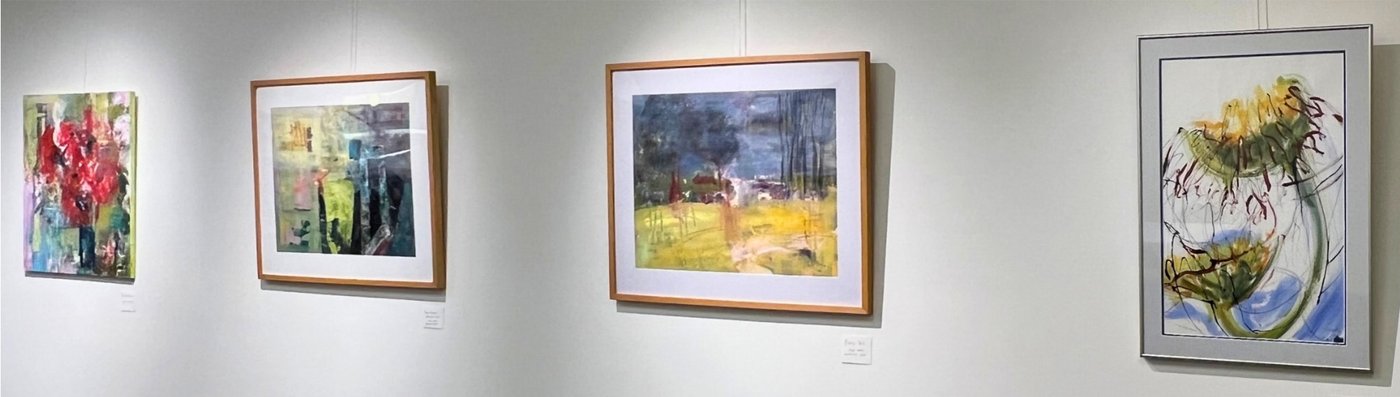
When I first wrote about Helen, much of our conversation was about layers, returning, and the long timelines inside a creative practice. One painting had begun some 30 years earlier, while newer collages incorporated pieces of older paintings. I left thinking about Helen’s trust in slow transformation and how the things she cultivates keep growing.
Among the work hanging at the library are pieces from Helen’s Hampton Court and Bushy Park series. Bushy Park has been in her creative life for decades. Her sister lived nearby, and Helen had lived there and returned many times. She has sketched and painted it for years, but told me it was only this year that she finally felt she had “captured some of the essence of the park.” There is something wonderfully Helen about that timeline.
Even while this work is hanging, Helen is thinking about what comes next. “The next thing that I’m really working on is the ocean,” she told me. “I have spent decades sketching, sitting, watching, walking, swimming, and I’ve never been able to pull off what I really want to pull off.” This winter, she is going for it. Huge canvases and sheets of raw canvas are waiting, and she has been at the beach taking photographs and sketching, studying the ocean and everything around it.
Helen is still doing exactly what first fascinated me about her work: observing, experimenting, returning, and allowing an idea to take as long as it takes.
That feels fitting for my Creator Spotlight series, too. I go to people’s creative spaces, look at what they make, and we chat. My natural avoidance of prepared questions creates space for the conversations to wander through art and process, but also place, work, family, memory, and whatever else turns up.
There is such an abundance of artists on this island, creating in wildly different ways, and getting to commune with Quadra’s creatives feels a little like speaking directly to the heart of the island. They welcome me into their homes and studios and trust me with their work, their stories, and pieces of how they see the world. We have the most human, beautiful conversations. That has become what I treasure most about Creator Spotlight, and one of my favourite parts of the Bird’s Eye.
Occasionally, the job gets me out creating art myself! A few weeks ago, I took an introductory linocut workshop with Quadra artist Nadine Bariteau at the Campbell River Art Gallery and carved the raven you see here. It was my very first linocut and I loved it enough that I immediately bought supplies and started dreaming up what to carve next!
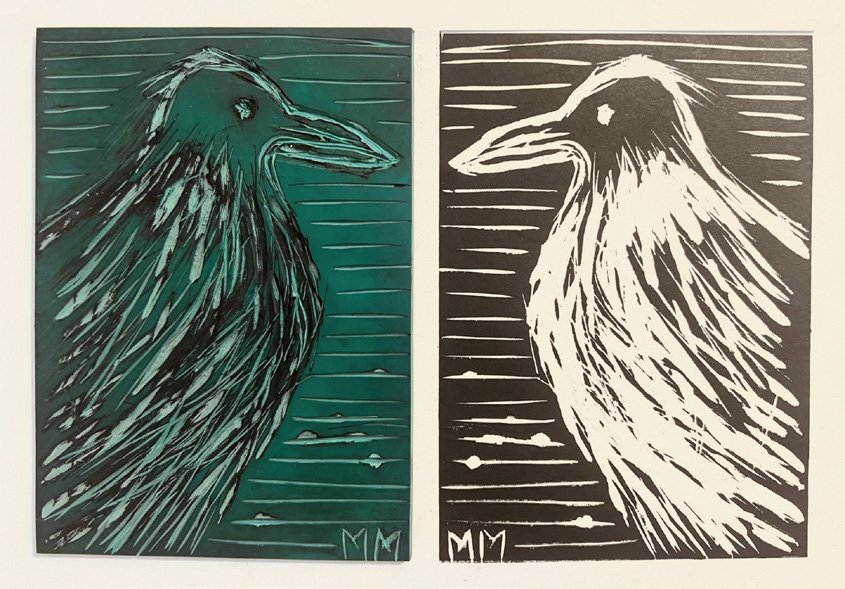
This fall, a series of four printmaking classes with Nadine is being offered: screen printing Nov. 14, drypoint etching Nov. 21, collagraphy Dec. 5, and linocut Dec. 12. Each three-hour workshop is $40, with registration at crartgallery.ca/events. She has a much bigger vision for printmaking at the gallery, too, which we’ll get into in her upcoming Creator Spotlight.
In other exciting news, one year in, the Creator Spotlight series finally has a home online. At thebirdseye.ca/creator-spotlight you’ll find all eight installments, the artwork that originally ran alongside them, and, as it continues, each new art-icle will live there too.
I have an ever-growing and seemingly never-ending list of Quadra creators I want to sit down with, so the gallivanting and chitty chatting are sure to continue. And make sure you’re sending along any names you want to see in these pages, too! If the first year has taught me anything, it is that I am probably going to need more pages.
If you think I can write too many words about civic governance, you should know that every time I have the pleasure of chatting with an artist (or two), I want to write a novel! Which brings us into our eighth installment of Creator Spotlight, a series I created as a totally valid reason to gallivant this fair island chitty chatting with artists!
This week’s adventure took me to visit Sylvia Yung and Ron Hilliard, whose shared life on Quadra is as much about making room for other artists as it is about creating their own work. And there’s a particularly good reason to introduce you to them now: the Quadra Island Studio Tour is looking toward its next chapter, and everyone with an interest in art is invited to be part of the conversation this Sunday.
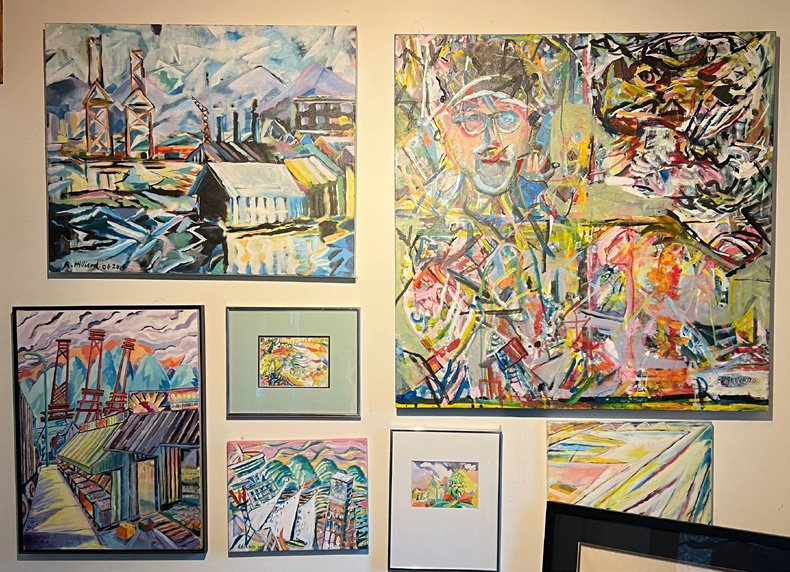
Sylvia and Ron both attended the Vancouver School of Art, now Emily Carr University, though years apart and long before they met each other. Ron studied painting, sculpture, and ceramics, while Sylvia studied painting and printmaking. Both pursued other careers while keeping art in their lives. Ron became an art therapist and later worked in mental health, while Sylvia’s varied career included fashion, business, and management.
They met soon after Ron retired in 2010, discovered Quadra together in 2014, and settled here in 2019. Drawn in by the island’s remarkable artistic community, they set about finding a place where they could devote more of their lives to making art. It took several years, but they found their spot among the trees. Their beautiful home is now filled with art, musical instruments, doting pets, and, perhaps most lovely of all, the deep love and care they have for one another.
Today, their Kamaole II studio is home to far more than their own creations. Since around 2024, they’ve been welcoming other artists into the space, building a collective where people can work, experiment, and share their art, whether or not they have studios of their own.
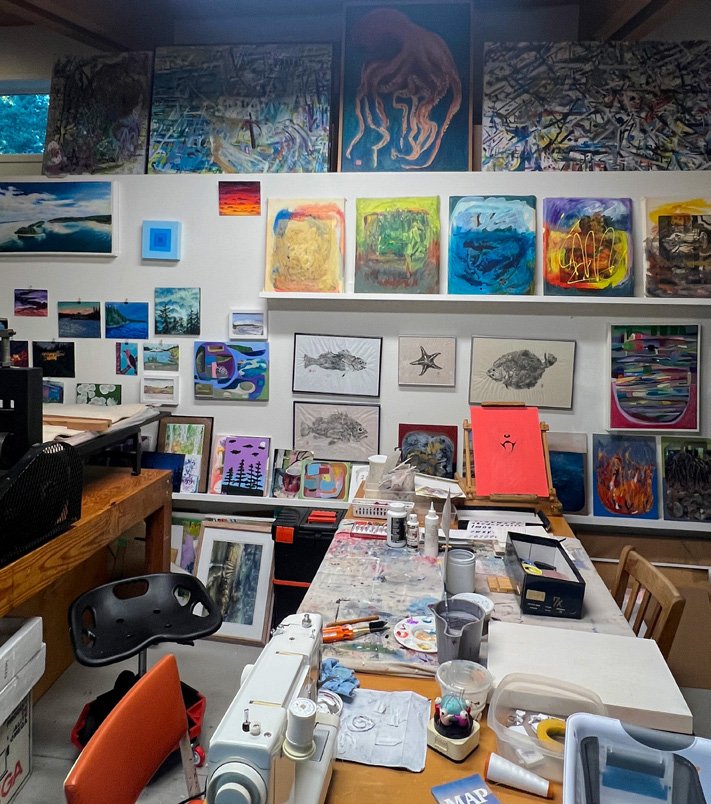
Among the artists Sylvia mentioned during my visit were Yvonne Corbett, Arlo Nicoll, Lucas Gentina, and 9-year-old Zach, who declared upon joining that there simply wasn’t enough art in school. Their studio also features work by other local creators, with an impressive variety of media represented.
A substantial printmaking press donated by artist Perrin Sparks arrived just a few weeks ago. It has taken some rearranging to accommodate it, but the possibilities for future creative activity are exciting.
That spirit of sharing is also central to Sylvia’s hopes for the Studio Tour. As the event grows, finding room for more participating artists, both on the tour map and in physical studios, has become a challenge. One solution they’re looking at is encouraging artists to share spaces, allowing those without dedicated studios to participate while fostering further collaboration.
Sylvia is also preparing to hand over her role as committee chair to Megan Bain, while remaining involved with the Tour. She hopes more young artists will join the committee and help shape the tour’s future.
This is where we return to Sunday’s invitation. The Arts Meet & Greet takes place October 25 from 4:30 to 6 p.m. upstairs at the Community Centre. Artists, prospective Studio Tour participants, and the art-curious are all welcome. It’s an opportunity to meet others in the community, exchange ideas, and discuss possibilities for the June 2027 Studio Tour, including new ways of bringing artists together. Curiosity is a perfectly good reason to attend!
Throughout our visit, Sylvia returned more than once to a phrase she shares with Ron: “We’re living the dream.”
There’s something beautiful about finding a person, a place, and a purpose that make you feel that way. Neither Sylvia nor Ron spent their entire working lives making art, but neither ever stopped making room for it. Even when life took them in other directions, they kept listening to that calling, and now they’re sharing their love of art with an entire community.
We tend to imagine our dreams waiting somewhere in the future, once everything falls into place. But perhaps there’s something wonderful about staying close to the things that make us feel most ourselves, without worrying about exactly where they’ll lead. Sometimes that brings you to a home among the trees, filled with art and the people you love. And sometimes it brings you to a couch at one in the morning, putting the finishing touches on a newspaper. Life doesn’t have to be perfect to be the dream.
Welcome to the seventh installment of our Creator Spotlight series, where we chat with talented folks on our island to learn a little bit more about their processes, stories, and ideas. Back from a summer break, this month we have a very Quadra kind of logic: giving a giant and actively used propane tank a second life as a canvas.
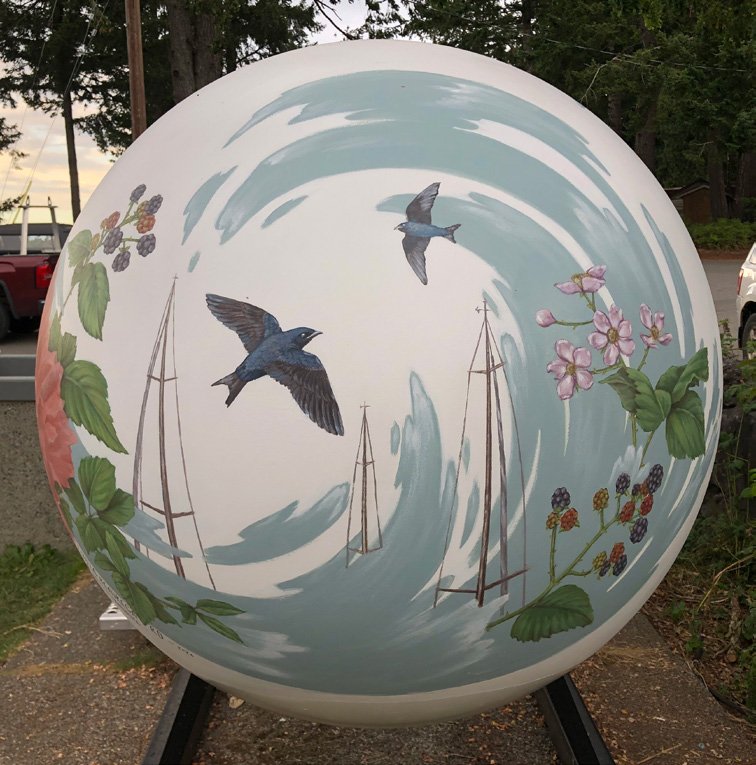
The Heriot Bay Inn’s tank had already carried a mural for roughly 20 years when artist Lydia Beauregard was asked to reimagine it. The request was simple enough: create something that felt like the Inn, its grounds, and the place people had arrived in. Lydia filled the curved surface with colour, flowers, birds, fish, and other familiar pieces of the coast around us. The challenge was making all of that feel fresh on a canvas that also happened to be round, curved, and full of pressurized liquefied petroleum gas.
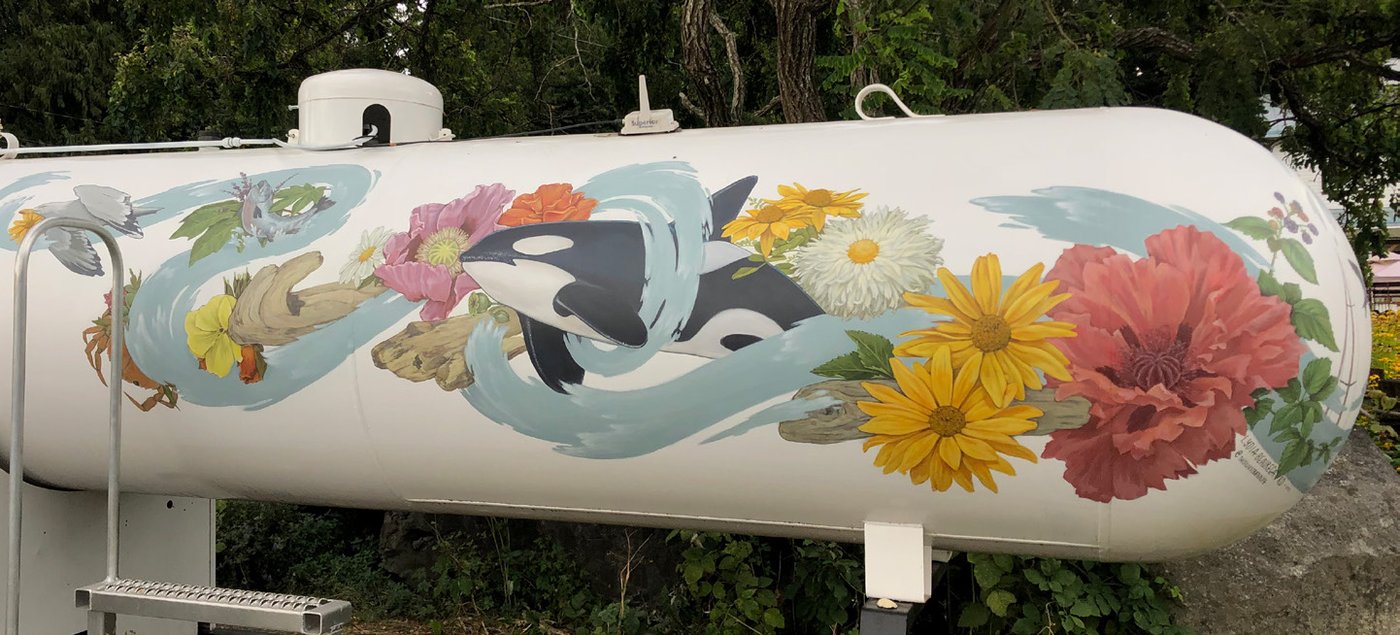
The final direction was intentionally simple: something welcoming, peaceful, and rooted in the feeling of the place. Lydia described beauty, serenity, and peacefulness as feelings she wanted the piece to hold, with colour doing much of that work.
“The colors mean everything to me,” she said. She especially loves when people notice the palette itself, because for Lydia, the feeling created by a piece can matter more than exactly what it depicts. “I feel something when I look at this. It barely matters what it is.”
The shape of the tank changed the process too. Lydia had a clearer plan for the front, but once she worked her way around the curved surface, improvisation took over.
“What belongs here? What am I going to paint next?” she remembered asking herself. From there, she followed what inspired her while she was on site. There may have been another version she could have planned in advance, but she came to appreciate what emerged instead: “The story that came through is inevitably going to be the right one because it’s based in the place.”
Painting at the Inn also meant Lydia was rarely working alone. Guests, locals, and people passing through stopped to talk while the mural took shape.
“Half of the work was just hanging out and chatting with people,” she said. After spending time away from making art publicly, Lydia had forgotten how much those encounters mattered to her practice. “Instead of painting alone at home, I’m there, you know, kind of performing and hanging out with everybody.” Those conversations and encounters become part of the work too, shaping the practice as she goes.
That confidence has taken time. Lydia is now in her eighth year of painting, after years of drawing and digital illustration, and says something shifted around year seven.
“Now I understand so many things that I didn’t understand before,” she said. It opened up a different kind of trust in what she could make, and in her ability to get an idea out of her head and into the world. “Now I can do that. I can trust myself.”
That growing trust may also mean making peace with something Lydia has resisted: painting things simply because they’re beautiful.
“I can’t just be pretty,” she said of her instinct to add contrast or an edge to her work. Flowers, however, keep making a convincing argument. “It’s so fun to paint the flower. It’s so emotive. It’s so full of movement.” She laughed that eventually she may have to become “less resistant to just continuing to add the flowers to pretty much everything.”
Luckily for Quadra, Lydia is open to considerably more than flowers and propane tanks. She takes on murals large and small, painting commissions, signs and lettering, boat names, portraits, illustration and design work, and, in her words, “most odd jobs.” She is also a certified boom lift operator, which considerably expands the definition of available canvas.
You can find Lydia Beauregard and her work on Instagram at @thisillustratedlife
There are spaces you enter for the first time that feel, inexplicably, like you’ve always belonged in them. Kris Wellstein’s mostly finished greenhouse is one of those spaces. I walked in and immediately had an imaginary martini in hand, a good book, and the sound of rain on glass overhead. Then it became a cocktail party. Then I remembered I was standing in a greenhouse and that the garden part is probably the main point — though I maintain the party potential is significant.
Welcome to the sixth installment of our Creator Spotlight Series, where we celebrate the artists, makers, and builders whose work shapes life on this island. This month we’re looking at something a little different — the art in building, and the magic that happens when the right person gets handed a vision, a scrim pile, and total creative freedom.
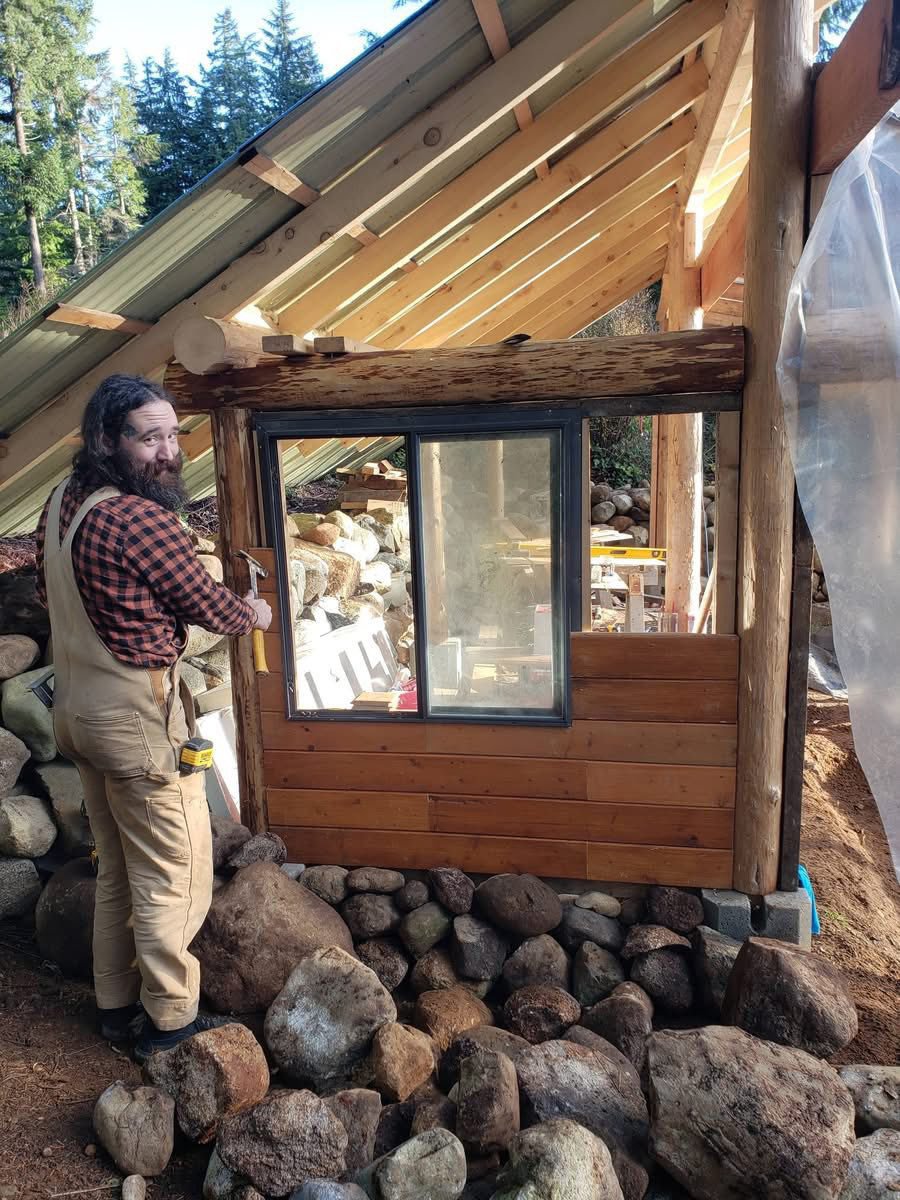
That vision belongs to Kris. She has been collecting things for years, not always knowing what they’d become, but knowing they’d go somewhere. Not quite an order pile, Midge says. She has a word for it: her scrim pile. It turned out to contain almost everything the build would need. Wharf planks. Salvaged glass. Secondhand windows. Rocks hauled by hand from the property and the roadside over nearly two years. Almost nothing was bought new. Kris knew what she wanted. What she needed was someone who could take a pile of salvaged everything and turn it into something.
Enter Midge Salter. Sparktologist — a decade of electrical work, no formal ticket, all the knowledge. Builder of many things. “I’m a snail,” he says. “I just bring my house wherever I go.” It’s a particular kind of freedom, the kind that comes from having skills that travel and the willingness to follow them. To go where the work is interesting, figure it out when you get there, and your house comes with you.
Ask Midge about building and he’ll tell you everything is math. His job is math. And the thing about math — do it right and it stops looking like math entirely. The perfect equation for a thing ends up looking beautiful. Curves and circles, nothing rigid, everything working out exactly as it should. Almost like it was always meant to be. That’s where the art lives for him — not in spite of the precision but because of it. He holds himself to a standard most people wouldn’t bother with. A mentor’s voice lives permanently in his head — a carpenter whose bar is so high that Midge still goes back to work alongside him occasionally, just to make sure his own standards haven’t imperceptibly slipped. Not because the work isn’t good. Because good isn’t the point. Code is the floor, not the ceiling. Everything above that is where craft becomes something worth looking at.
Which brings us back to the greenhouse. Kris came to Midge with a drawing and a dream — glass faced, half sunk into the hillside, built from Kris’ bounty of gathered materials. Nothing was perfectly straight. Beach posts aren’t. Salvaged glass doesn’t forgive. Every decision led to the next one, and when something couldn’t be built the way it was imagined, Midge found another way and made it look intentional. The ventilation alone — cool air drawn in low, warm air pushed out high — is its own small piece of engineering tucked into the angles of the thing. Total creative freedom, one condition: don’t make it ugly. An ask built directly into the way Midge operates.
The greenhouse may be built, but it isn’t finished yet. Interior panels will be painted, paths still laid, baby lemon trees to procure. There’s talk of a greenhouse warming party when it’s ready — which seems appropriate for something born from a desire to create and share knowledge around food security, and built from the kind of community that shows up with salvaged glass and a scrim pile full of possibility.
As Midge and I settled in at a picnic table at Rebecca Spit, sunshine beaming, hungry raven fledglings calling out from the trees above us, I told him not to worry — this was more of a chat than an interview. He didn’t miss a beat. He’s been interviewed for a number of things, he said. When I pressed him for the list: skateboarding, filmmaking, and police reports.
Midge Salter: self-identified snail, sparktologist, builder of many things, and a person whose math has a way of becoming beauty. As is tradition on Quadra, he contains multitudes. If you would like to connect with Midge to discuss a project, you can email him at: harveyspannos@gmail.com or give him a call at 778-823-2583.
The next Creator Spotlight will appear in our June 24 issue. If you know a Quadra-based creator, maker, or builder whose work deserves a closer look — or if that person is you — we’d love to hear from you.
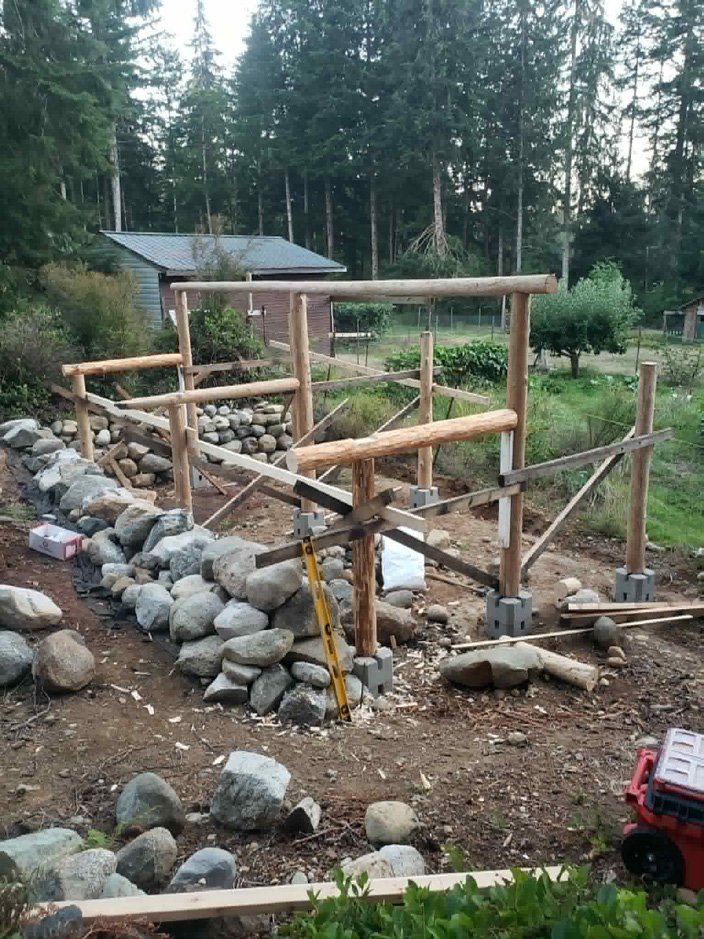
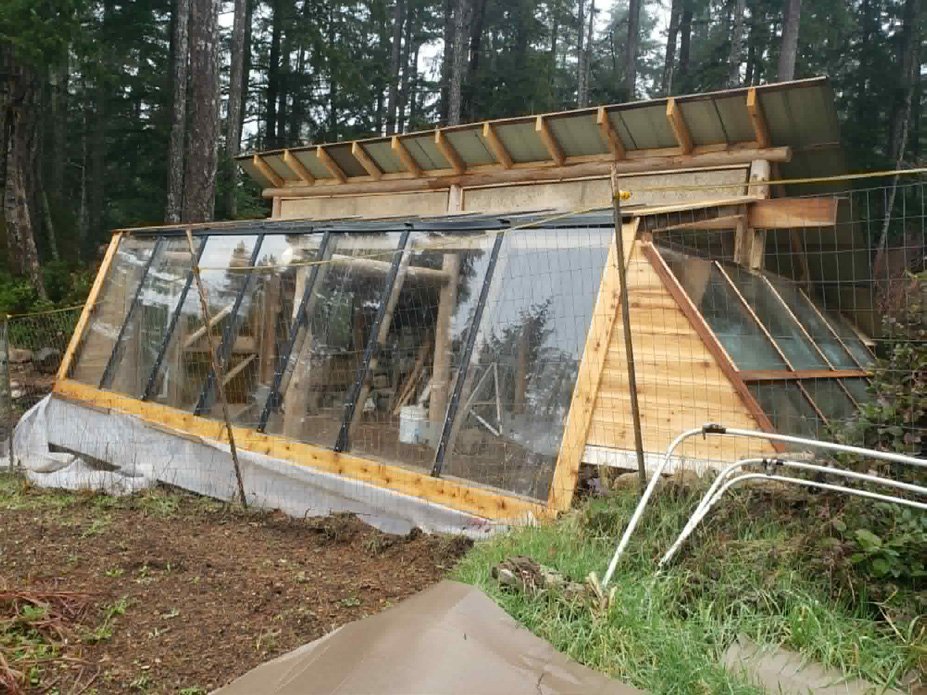
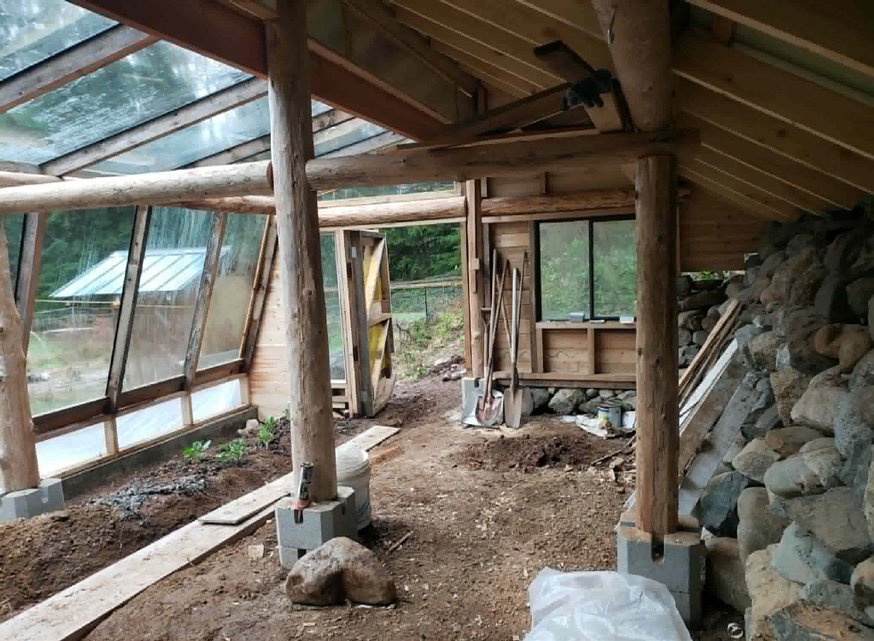
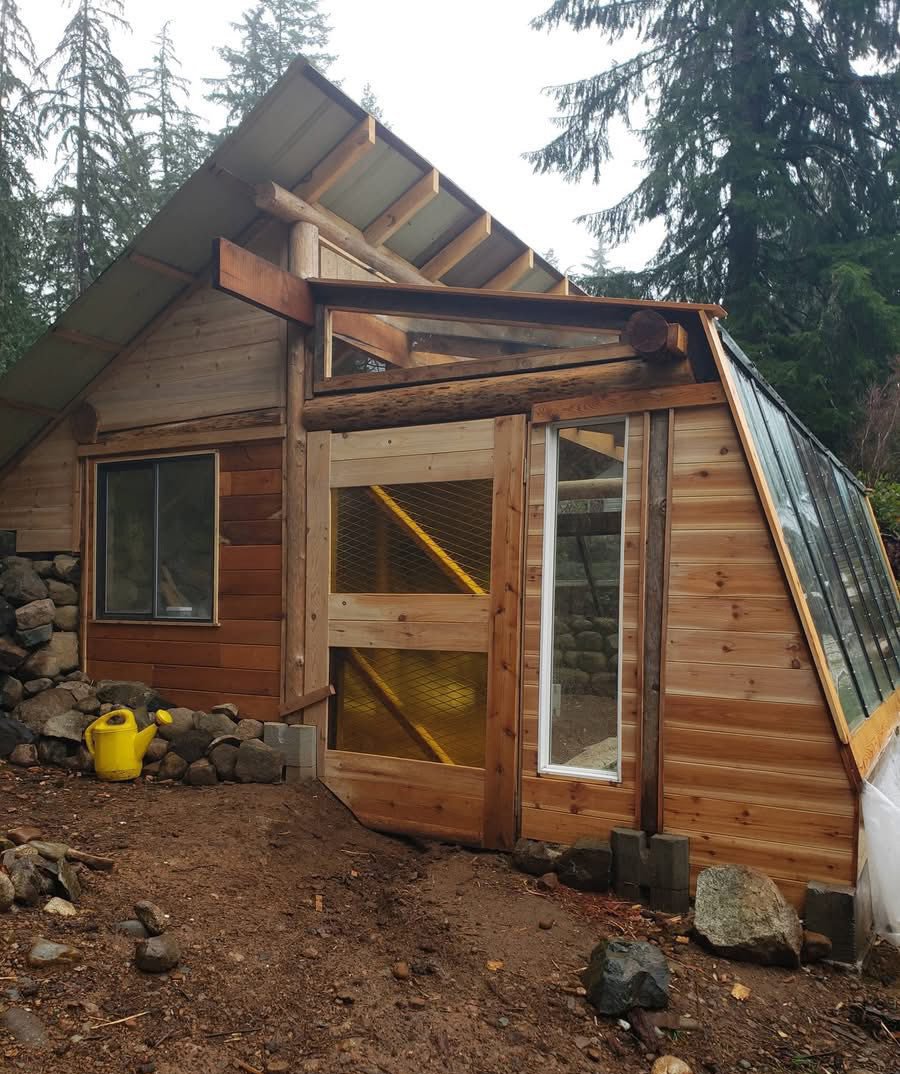
Photos from building Kris Wellstein’s partially in-ground greenhouse. Built by Midge Salter using materials salvaged, recycled, and saved for just the right moment.
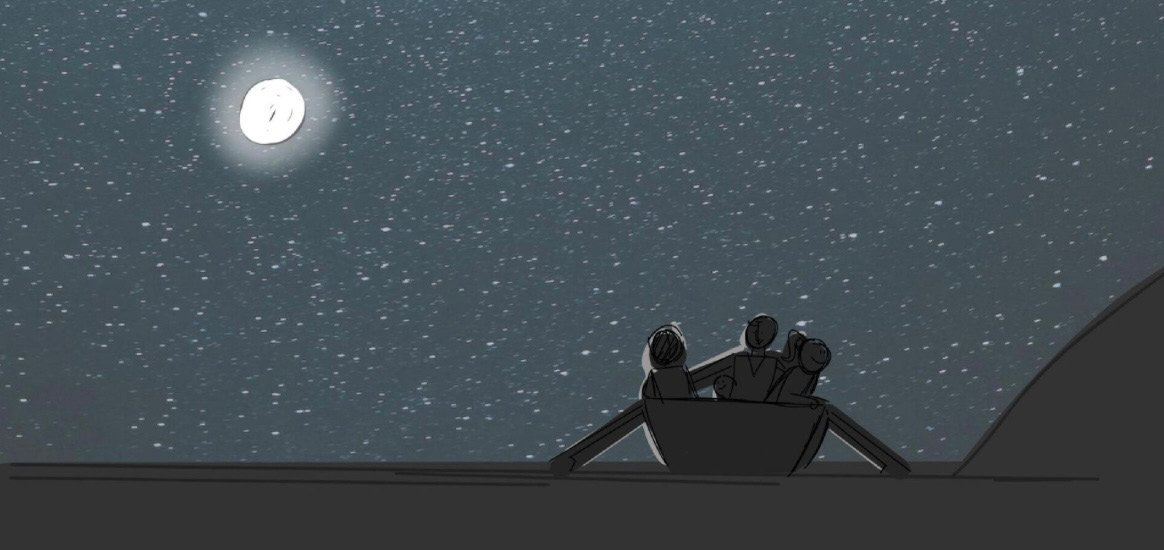
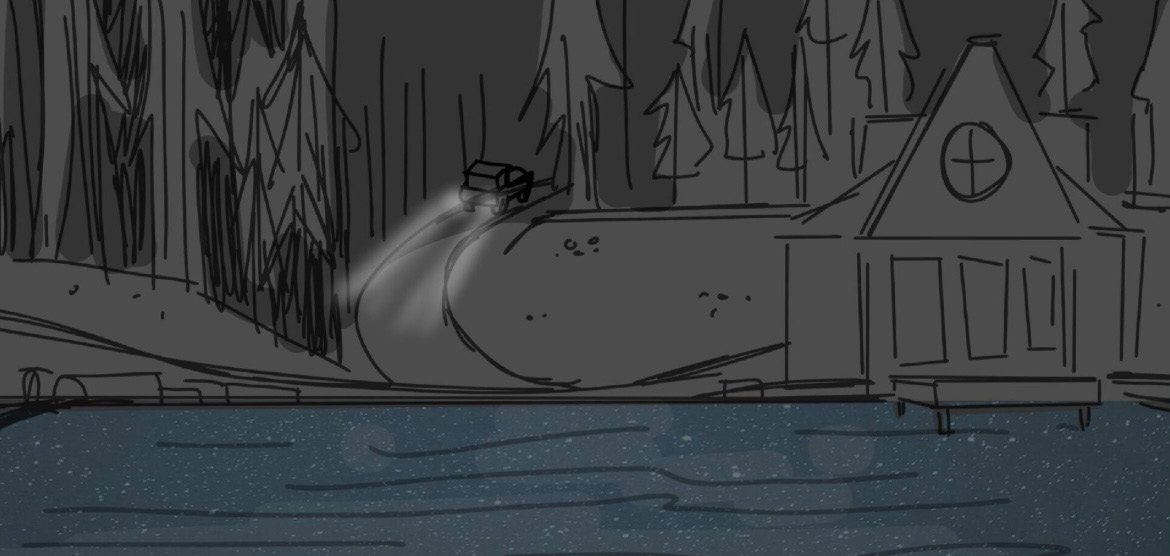
Welcome to the fifth installment of our Creator Spotlight — a monthly feature where art, life, and Quadra come together. This month’s conversation took us panel by panel into the world of local storyboard artist Sophie Whittingham.
Think about the last animated film or show you watched. The character who walked into frame and your eye just... followed. The background that told you it was evening before anyone said a word. The joke that landed perfectly because of exactly where the camera was, exactly how the character moved. You felt all of it. You probably didn't think about any of it.
Someone drew that. Every single element — the light, the room, the way a character's shoulders drop before they speak — was imagined by a person, translated into a drawing, and handed off to the next set of hands. Before the animators, before the voice actors, before any of the visible magic, there is a storyboard artist at their desk building the entire world from scratch.
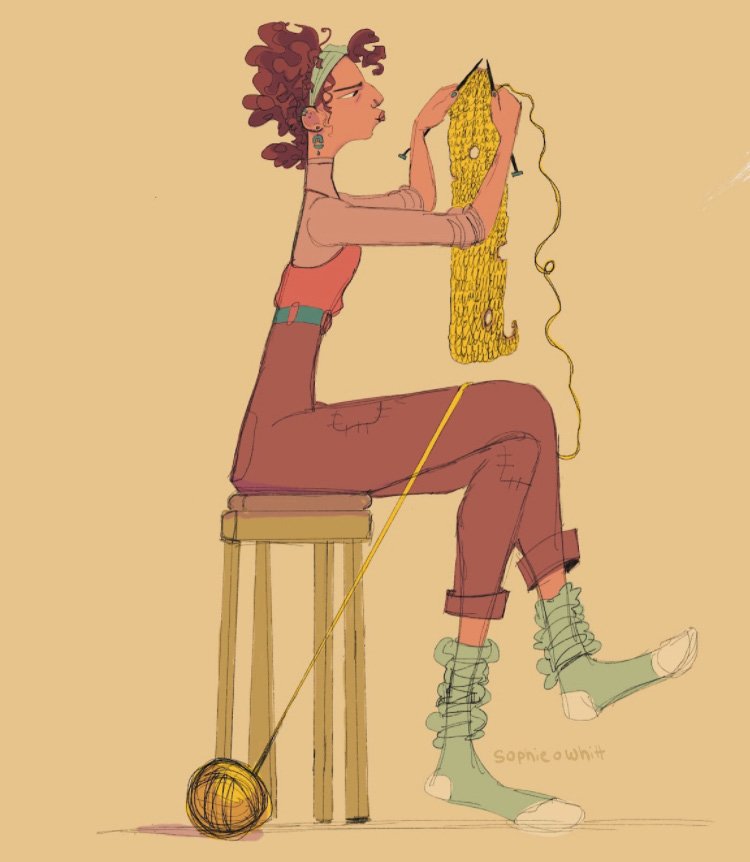
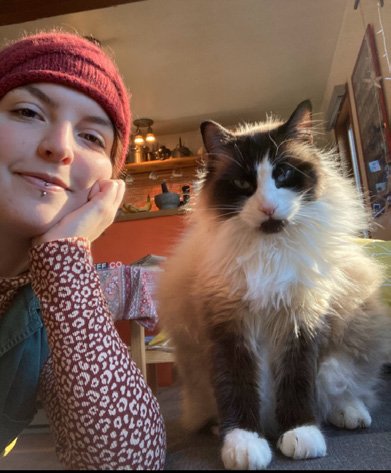
Sophie recently illustrated A Life Amongst Cats, a new book of poetry by fellow Quadra Islander Chris Thompson, available by donation at Inspirations. The 80-page collection — poems, illustrations, and a whole lot of feline personality — is a fundraiser for Quadra Cat Rescue, and Sophie's drawings are the kind of work that pulls you in frame by frame.
Sophie grew up on Quadra, homeschooled and drawing from the time she could hold a pencil. By twelve she was making stop-motion animation, occasionally submitting it as schoolwork — history projects brought to life one painstaking drawing at a time. Growing up surrounded by creative adults and equally creative friends, pursuing something artistic never felt like a leap. It felt inevitable.
She left for Vancouver straight out of high school to complete a two-year animation diploma at Capilano University. The workload was intense, acclimating to city life from Quadra was its own project, and that particular kind of pressure followed her straight into her first professional contracts.
She came back to Quadra in 2020 when COVID reshuffled everything, planning to stay temporarily. But Quadra has a way of reclaiming its own. Six years later, she's still here.
Though still early in her career, Sophie has already storyboarded for some recognizable names — Monster Wheelies, Curses for Apple TV+, and Diary of a Wimpy Kid: The Last Straw for Disney+. She also works with DreamWorks TV.
And then there's the one that got away. Working for Aardman Animations — the UK studio behind Wallace and Gromit — is the reason Sophie got into animation in the first place. She was even hired by them, but then her visa didn't go through.
However, Sophie has a direct message to the team: “If you are reading this article, you should hire me.”
Aardman, consider this your formal notice.
In Diary of a Wimpy Kid: The Last Straw, there's a scene in a principal's office where a kid's drawing appears on a post-it note. Sophie drew that little scribble in her storyboard — just a quick sketch of what she imagined a child's drawing would look like — and they kept it exactly as she drew it!
Like a lot of artists who go professional, Sophie's relationship with her work has become more complicated over time. After an intense first contract she took some time off, not sure she was coming back to animation at all. But something continued. Her artist brain never stopped — observing, collecting, images that caught her eye, every little thing that stuck had nowhere to go yet.
When she eventually sat back down at her storyboard, it hit her all at once. "All the moments that I had noticed in day-to-day life," she says, "they finally had a vessel again." Like drinking water when you're thirsty, she says. Like a pressure valve releasing.
That pressure valve feeling — the relief of giving all that collected energy somewhere to go — is something most of us can relate to in one way or another. A spinning mind, a heavy week, a feeling you can't quite name — art has a way of holding all of it.
Sophie's manifesto for all of us: There's no bad art. Just make it.
Ask Sophie what shaped her creative eye and the list tells you everything. Wallace and Gromit. The cut-out animations of Terry Gilliam in Monty Python. The gloriously weird French film Triplets of Belleville. And Flushed Away — which she will tell you, with complete sincerity, is the one thing you should take away from this entire article if you take away nothing else.
What they have in common isn't studio size or budget. They're handmade-feeling, weird in the best way, and completely committed to their own vision.
With Sophie starting a new contract next month, her artist brain is already quietly collecting. And somewhere out there, Aardman still has her number. But for now, we're glad Quadra has reclaimed her. And that A Life Amongst Cats is available by donation at Inspirations, with all proceeds to Quadra Cat Rescue.
The next Creator Spotlight will appear in our May 27 issue. If you know of or are an artist/maker and are interested, reach out!
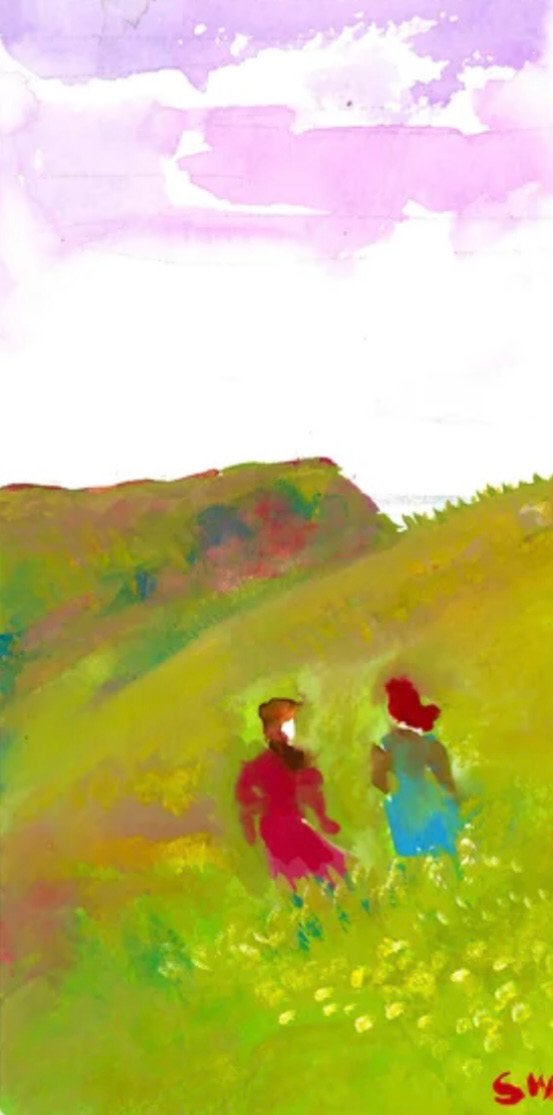
“Why don’t you tell me a little bit about what you enjoy creating?”
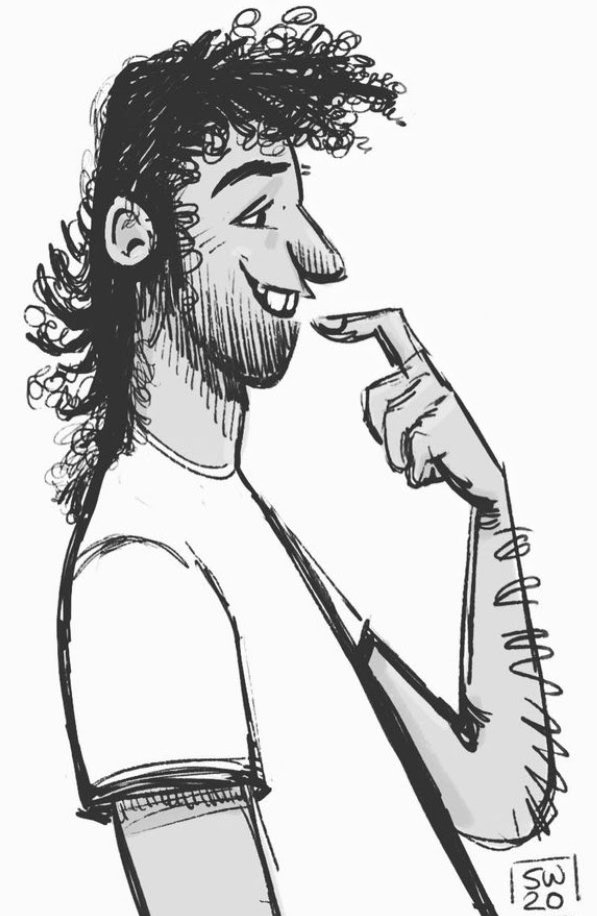
What seemed a simple question revealed itself quickly as a gateway to something much bigger — especially when the artist is as comfortable producing richly layered watercolour and oil paintings as they are building evocative soundscapes from field recordings gathered in the forests and shores around them. In this case, that artist is BAM.
She has been making things her entire life — she was the kid asking her dad how to use a jigsaw, not to build something she’d been shown, but to cut plywood into a design she’d already imagined.
For BAM, making is less a choice and more of a calling. There is a philosophy underneath everything she does, one that has less to do with medium or output and more to do with listening. She describes her current creative practice as a kind of receptive surrender, a willingness to stay quiet enough to hear what the moment needs and then meet it there. “Different versions of medicine for the moment,” she calls it. What that medicine looks like has changed many times over the years. What has never changed is her commitment to following the call.
That call, she says, is often relational. Creativity for BAM is not a solitary act, rather it is an exchange. It is stoking someone’s fire and having yours stoked in return. It is being asked to make something by someone who has never seen you make that particular thing before, but trusts you anyway. That trust, she says, is everything. It is how she knows she is participating in the world the way she is meant to. Like ivy, her path to that knowing has wound and climbed and doubled back, finding its way not by force but by feel.
“Very publicly, very obviously — a contemporary artist.”
Quadra Island has counted BAM as a resident for over eight years now. In Vancouver, she had built a whole life on different versions of creative work — some that paid the bills, some that supported play, nearly all of them pushing the limits and allowing BAM’s practice to deepen into something wholly her own. She didn’t choose to walk away from it. But somehow she found herself here, with a friend’s encouragement and a loose plan to build a small studio. What she built instead was a house — and in doing so, began the long work of building a truer, more authentic version of herself.
No matter what was unfolding in BAM’s life, her creative instinct remained — finely tuned and always finding new materials.
Watercolour, which taught her something essential about surrender. Oil. Textiles and natural dyeing. Then sound: field recordings layered into collage soundscapes that she still speaks about with a particular kind of wonder. Metal. Wood. Each medium arriving when it was needed, each one another tendril of the same reaching thing, teaching her something the last one couldn’t.
Then there was the house itself. She arrived to Quadra with basic carpentry skills and learned the rest by doing — structures, systems, the particular patience that off-grid living demands. Carting water. Building fires. Figuring out a mortise and tenon joint. Productivity looks different when washing the dishes means first hauling the water to boil on the stove. Rituals are born from basic steps that way, and the slowness of it all turned out to be its own kind of medicine.
Those years were not without their losses — personally, in community, and globally — she describes them as reactionary. It took a full Saturn cycle, she says — marking a major life reckoning or a cosmic “coming of age” that in astrology terms takes nearly 30 years — to figure out what she was even up to. That fluidity had carried her through a lifetime of mediums and reinventions. This time it met something newer — a deeper self-awareness, hard won through all of it, that recognized her heart’s desire was somewhere else entirely. “I hadn’t really been participating in the world,” she said, “in the way that I know I’m meant to.”
Like ivy on the side of a house, you can’t always tell where it’s going, but it always finds its way through. Across her years on Quadra, BAM has taken on metalwork and woodwork commissions, contributed to festival installations, created community textile installations, tended the Old Farm Community Garden, collaborated on public sculptures, and much more. Without ever performing the artist role, she arrives as herself because making and connecting are how she moves through the world. The art has always been ever-present.
It rained intensely for most of the day BAM and I shared space, but for those hours spent together, we were bathed in the warmth of early spring sunshine. Sitting outside, the conversation wound like ivy through vastly varied terrain, climbing, reaching, always finding the light. Driving home as the rain fell again, I felt like BAM had taken a fresh paintbrush to the grey-est grief-stricken corners of my chest and reminded me what a little colour and sunshine can do.
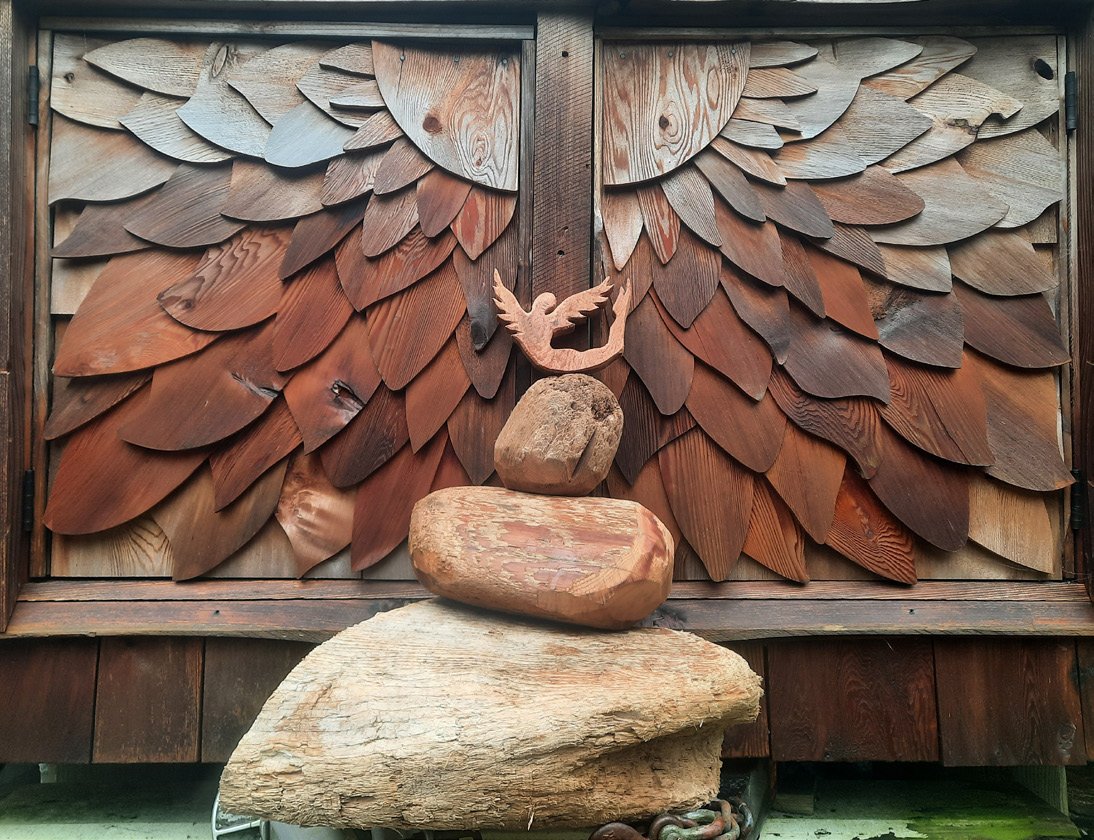
Do you have a “crazy idea” about something you want made and don’t know where to start? Or are you looking for someone skilled in a multitude of avenues — wildly talented, deeply grounded, universally connected, intuitive on numerous levels, and is also kind, compassionate, and caring? Chatting with BAM is likely an excellent idea. You can reach out to her via email: greatwaterxing@proton.me
Our Makers Spotlight skipped February — life had other plans — but we are back! Look for our fifth installment in the April 29th issue. Know a Quadra maker we should talk to? We’d love to hear from you!
Welcome to the third installment of our Creator Spotlight Series, a monthly feature that has already received an incredible amount of positive feedback. I’ve been genuinely touched by the overwhelming response to the first two profiles. It’s an absolute honour to sit down with these artists and just chat—there’s no set list of questions, only the organic path of conversation, allowing each interview to develop its own fingerprint.
This month’s spotlight is on Quadra-based artist Kathryn Manry, whose creative life is marked by a rare and steady self-trust—one that shapes how she works, when she changes course, and what she chooses to stay with.
Kathryn Manry has known she was an artist since childhood. As a kid, everything around her was covered in drawings. After graduating from art school she took a night class in pottery that changed the course of her practice entirely. What began as an evening course drew her fully into clay, and she went on to set up a studio in Calgary, supporting herself through pottery for nearly a decade. After developing carpal tunnel syndrome, she stepped away from clay and taught art while she healed. Gradually, she found her way back to the studio again—this time as a painter—carrying those earlier years of making with her.
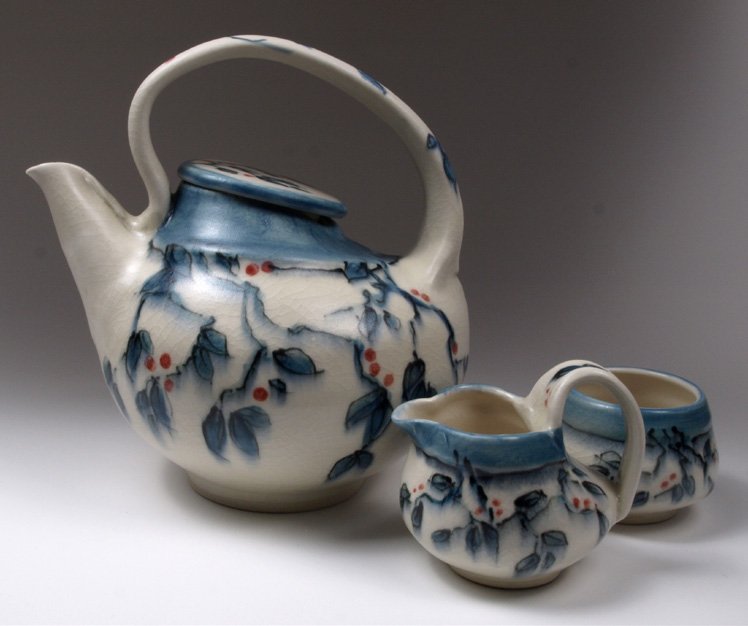
That commitment is visible in how she moves between materials. Working across both pottery and painting, she experiences them as engaging different parts of her brain and body. Pottery is rooted in form and repetition, unfolding over long timelines with delayed feedback at every stage. Clay requires patience, with much of the process spent waiting—drying, firing, cooling—before the result fully reveals itself. Painting, by contrast, operates through response and movement, with decisions made in real time as the work shifts and develops.
Within painting, she speaks with particular care about oil. Oils take time to dry, but once they do, they carry a strength and presence she values deeply. There is a physicality to working with oil—the ability to push the paint around, to work against resistance, to commit to marks that will remain once the surface finally settles. That physical engagement is inseparable from the finished work.
With art, there is an energy or intention felt within some pieces—a kind of clarity or flow. The paintings Manry feels that most strongly in, she said, are often the same ones other people respond to most. Those are the works that hold onto the experience of being made, whether that process was joyful, difficult, or emotionally demanding. It’s the energy—the connection between makers and their art—that remains.
Water is a common theme with Manry’s paintings, having seeped in through spending much time on it. Paddling became part of her life, and with it came a different way of seeing—one shaped by movement, reflection, and change. Her painter’s eye met a new perspective; being on the water altered the pace and conditions of seeing. Light shifted constantly. Surfaces refused to settle. What began as mostly abstract pieces moved toward water, then shoreline emerged, and eventually kayaks and figures appeared within the landscape.
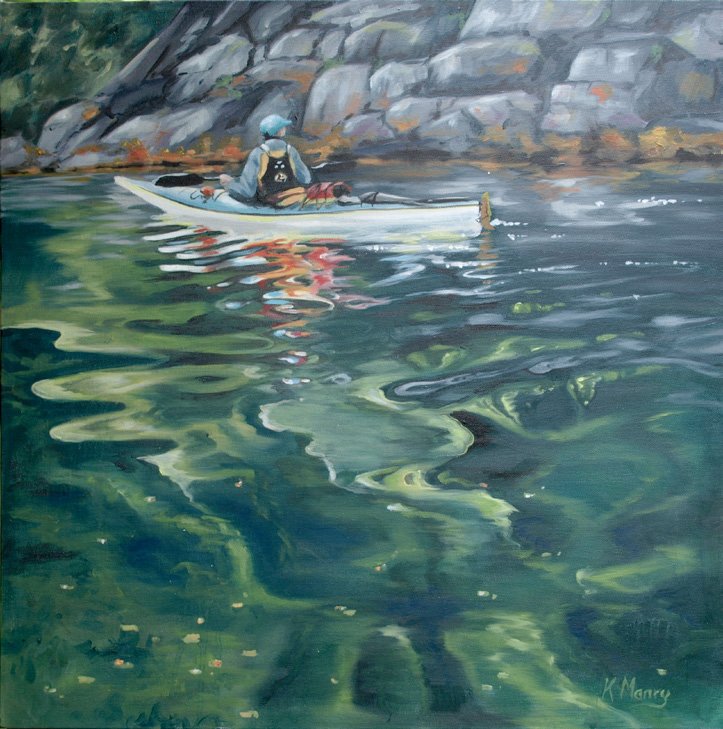
This latest phase of Manry’s life, she explained, is calling for something smaller and more immediate. Oil painting no longer fits her needs. Oil had been her primary mode of working for many years, so making room for a new direction required a decisive change. She sold all of her giant canvases and oil paints and cleared them out of the studio entirely. What remains are acrylics and watercolours—materials she can work with on paper, at a smaller scale, and with greater immediacy. Watercolour, in particular, is entirely new territory. Having never worked with it seriously before, she’s approaching with curiosity and trust.
She’s carrying that openness with her on her next adventure: Istanbul, Turkey—where she’ll spend three weeks with a sketchbook and watercolour palettes. Travelling with a sketchbook, pausing to draw and paint along the way, has always been part of how she moves through the world, but this trip is different. It’s an opportunity she’s long imagined: “to go somewhere and just stay in a place, and see it, through drawing and painting.”
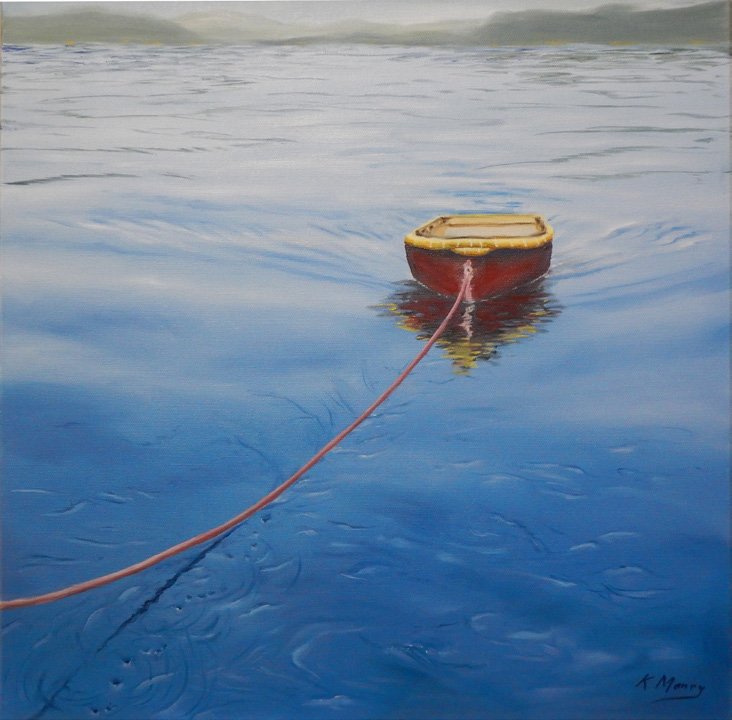
Following the inner knowing that has guided her since childhood, Manry is stepping into a brand new mode of expression. When she returns from Istanbul, she’ll be bringing back work shaped by a new medium, a new place, and a period of intentional openness. There’s something rare and compelling about witnessing an artist mid-pivot, as a new body of work begins to emerge. You can find her online at: kathrynmanry.ca and often as part of the Quadra Island Studio Tour. We think her studio tour is sure to be extra special this year.
Our next Creator Spotlight will appear in the February 25 issue. If you know a Quadra-based creator whose work deserves deeper attention, we’d love to hear from you!
Some homes hold stories the way others hold furniture. Stepping into Marni McMahan’s home and studio it’s immediately clear that objects here are not precious because they are protected, but because they are lived with. Her father’s handmade furniture still anchors the rooms. Antiques are used, not staged. At her art desk — the very desk she sat at as a little girl — work continues without reverence turning into restriction. Work exists alongside daily life, ideas pausing and resuming without ceremony, and objects carrying the quiet evidence of time spent with them. It’s clear right away that Marni’s art doesn’t begin in a studio and end on a wall — it unfolds through repetition, return, and care.
Originally from Ontario, Marni grew up in a family where looking mattered — art books brought home weekly by her father, long afternoons spent in museums and libraries, and an early education in proportion, form, and attention. Textiles were equally familiar. Her grandmother and aunt were skilled sewers, and fabric was understood as something worked with, handled, made useful. These influences accumulated quietly, without pressure to become anything. In her mid-twenties, that accumulation met urgency. A close friend named Mark — brilliant, generous, deeply alive — became ill with leukemia and died a few years later. The loss sharpened something already forming. “If Mark could die,” she recalls thinking, “so could I. I’m not putting anything off.” What followed was not a reinvention, but a decision to stop delaying what had been gathering around her all along.
Before Quadra, before teaching and travel, there was Kaz. What turned out to be a lifelong friendship began in teaching school and carried forward through adventure, uncertainty, and long stretches of living far from anything familiar. They travelled together, made decisions together, and learned how to navigate risk with trust as their anchor. Kaz was already an artist, someone for whom creative work was woven into daily living. That awareness led Marni to recognize a rhythm, and it already fit inside her artistic soul. Over time, that commitment took form in fabric — not suddenly, but through return.
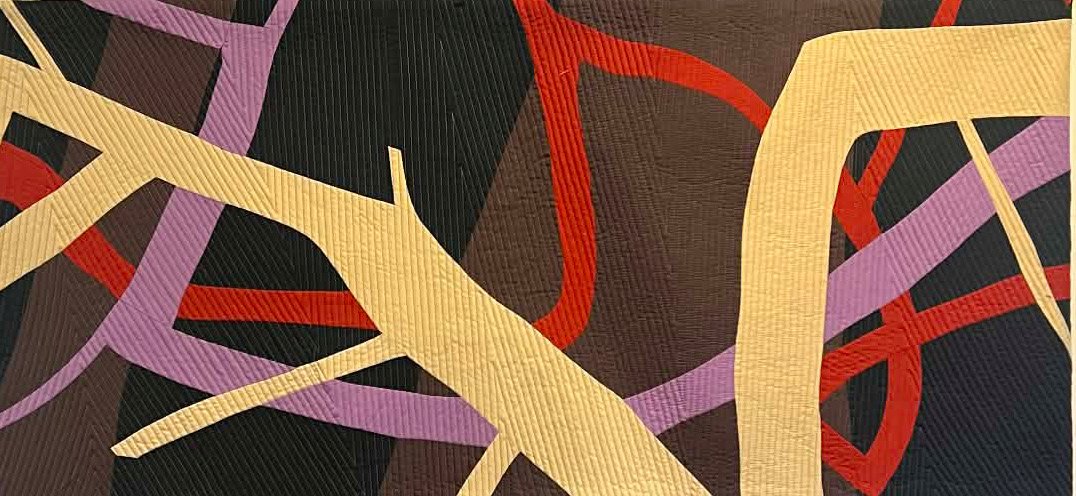
Marni works primarily in art quilts. She began with traditional and Amish-influenced forms before entering into sustained study with Nancy Crow, whose influence continues to shape her practice today. Through that lineage, quilting became for Marni not a decorative craft, but a contemporary art form. Her quilts have since travelled internationally in exhibitions, carrying that discipline and inquiry well beyond the island. Her current series is built from fabric, but governed by colour. As part of her work under Nancy Crow, she’s been working with a new system, value based — light to dark. Everything in between placed in its appropriate space, treating colour not as embellishment but as structure. Each shift carries weight. Together, the layers form a logic that is felt before it is explained.
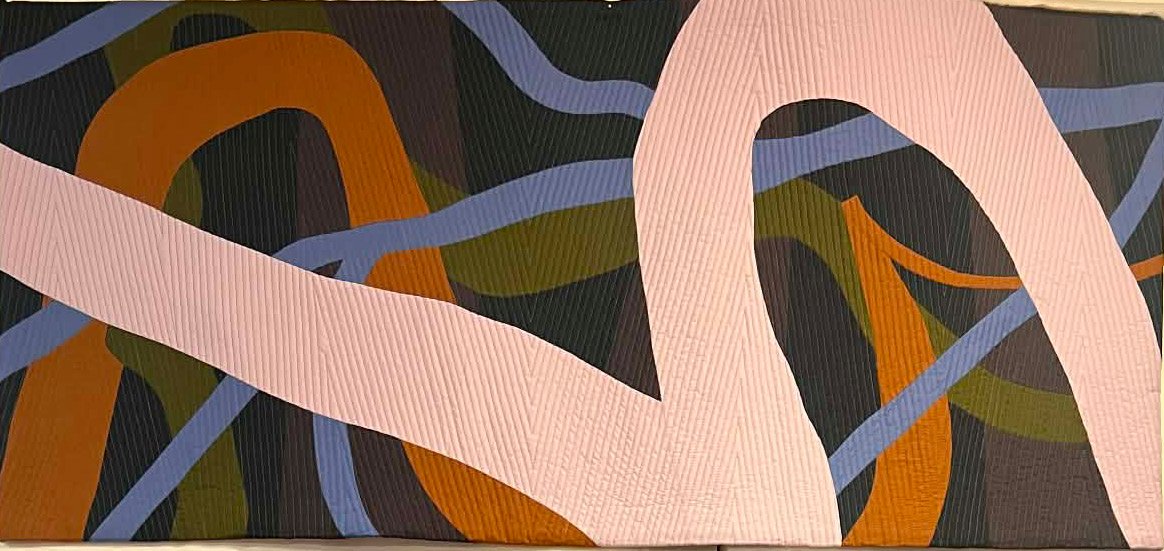
The pieces are constructed slowly and deliberately. Shapes overlap, paths intersect, and nothing is left loose. Fabric is cut, placed, and sewn again and again, held in position through repeated stitching. The result is abstract, but not accidental. Every layer remains present, visible in how colours meet and press against one another. Rather than resolving a piece and moving on, Marni stays with a form long enough for it to clarify itself. Progress, here, is not about arrival. It is about density — how much experience can be carried without collapse.
There is also an openness in Marni’s work to where materials — and influences — come from. Fabric can carry history, memory, or value from unexpected places, just as people do. Pieces intersect where they must, not always where they are planned to. In her quilts, disparate elements meet, overlap, and hold together, forming something stronger through their contact. It’s a quiet acknowledgment that the lives we touch — briefly or for decades — leave their imprint, shaping the whole in ways we don’t always anticipate.
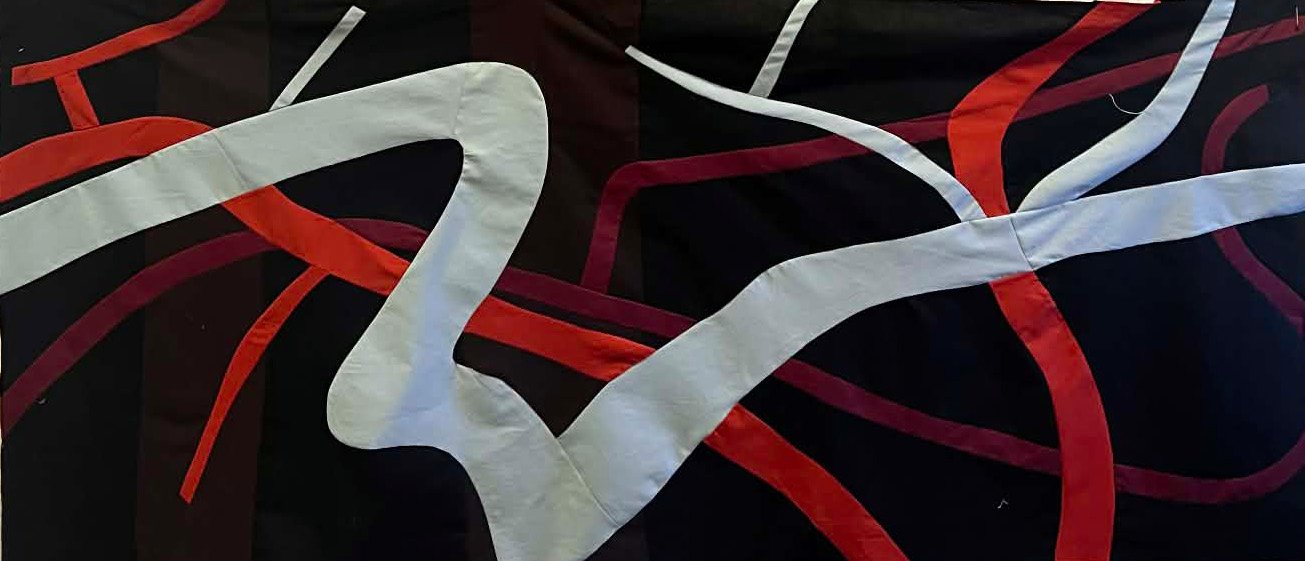
Living on Quadra for more than three decades has meant repetition without stagnation — familiar paths walked under changing conditions. Over time, Marni’s creative life has taken on the same rhythm, sustained by attention and patience rather than urgency. At the centre of her work is value. In the studio, that system is literal: colour moving deliberately, sometimes by barely a shade, drawing the viewer’s body closer to look, while decisions are held in balance long enough to reveal their strength.
The next Creator Spotlight will appear in the January 28 issue, continuing this monthly series in the final issue of each month. If you know an artist, maker, writer, sculptor, or creative working on Quadra — or if that person is you — we’d love to hear from you for future feature articles!
It’s no secret that Quadra attracts creative folks. Whether we’re painting, writing, sculpting, sewing, or building art out of beach treasures, this island seems to inspire us into making. We’re excited to launch a new series born from that energy. Beginning with this issue, the last paper of each month will feature a local creator and their work.
We begin with someone who has already shaped generations here: Helen Lee.
Many Quadra residents know her as a beloved kindergarten teacher whose classroom was filled with care, colour, and curiosity. What some may be discovering now is that she is also a remarkable painter — one who has been making art on this island for decades.
Helen has participated in the Quadra Island Studio Tour many times, welcoming visitors during the Studio Tour. In a beautiful shift, this is her first year as a year-round artist on the tour — giving locals a special opportunity to connect more personally with Helen and her art.
You can also find Helen at the Community Centre on December 6 for the Winter Market, where she and Michael Redican will be showcasing their creative work — Helen’s paintings, art cards, and one-of-a-kind Christmas cards, alongside Michael’s poetry and children’s books.
We are honoured to begin this new Creator Spotlight Series with Helen Lee — an artist whose influence has long been felt in classrooms, and now continues to flourish on canvas.
Stepping into Helen Lee’s studio on a rainy November afternoon is a transformative experience. Brushes bloom from jars like wildflowers. Loose canvases and papers gather in quiet congregation along the walls. The windows and Dutch door act like portals between the seasons.
One particular piece in her studio, Summer Lilies (pictured below), holds a history you can actually see. Helen began the piece some thirty years ago, the first layer still visible beneath everything she has learned since. She talked about it as a continuation — not a new beginning. The fluidity and freedom of the brushstrokes is held by the intentional restraint of keeping each generation visible. A thirty-year story, an archive on a single piece of watercolour paper, a story traced through time — each chapter still present, living together without erasing what came before.
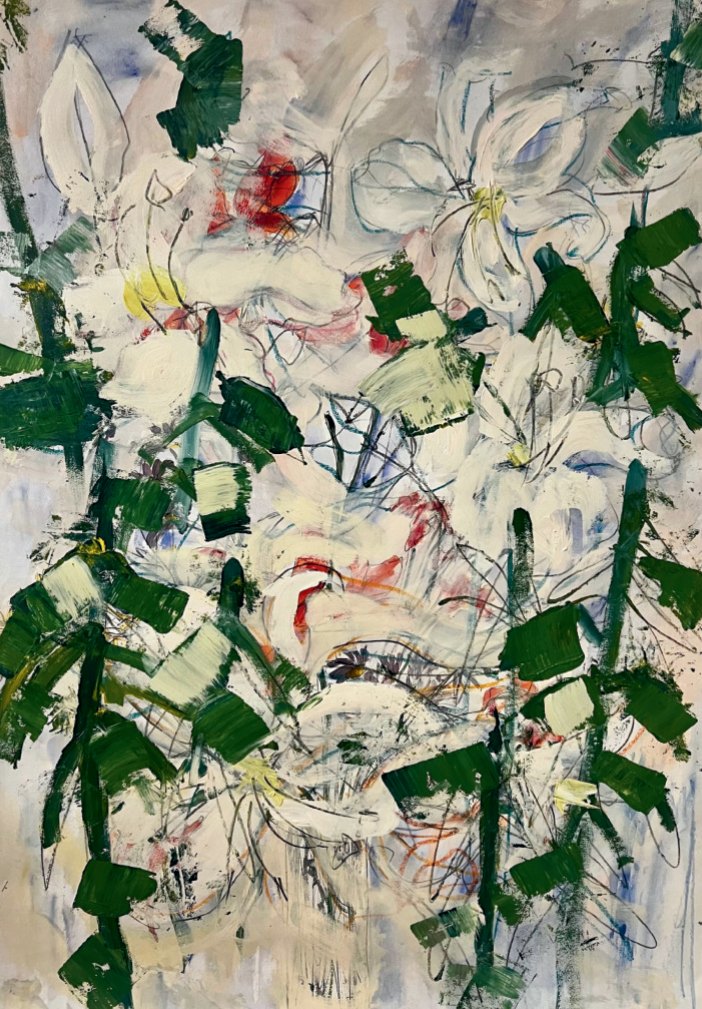
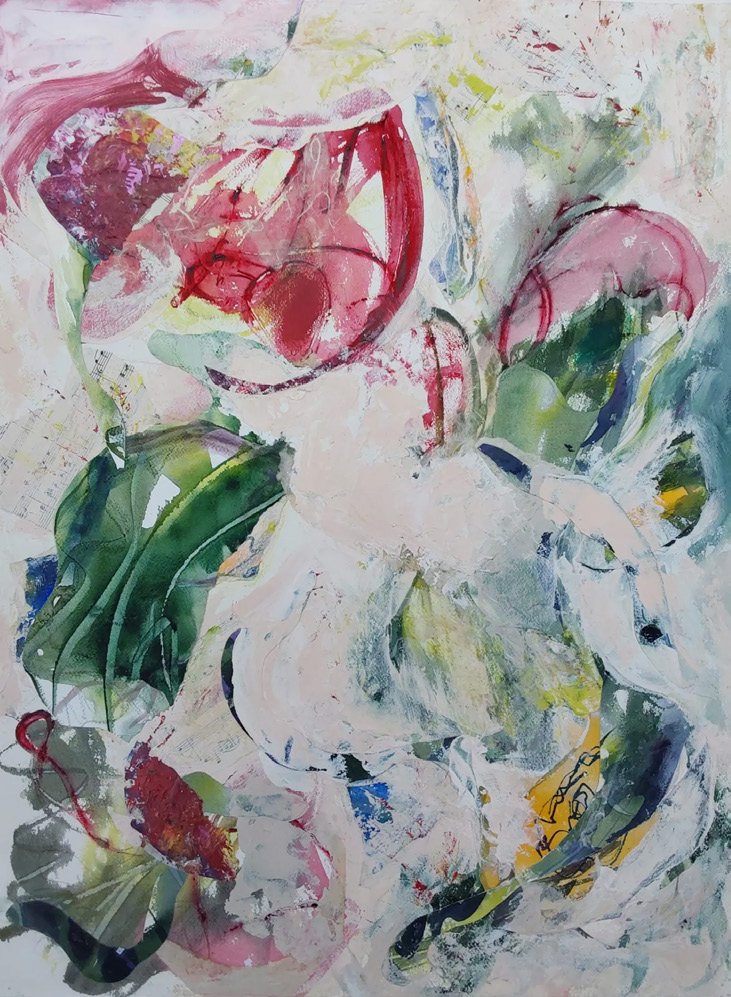
Helen works in a cycle — often in a series — shifting between pieces and letting each one teach her something about the next. This way of working deepened after taking an online course with artist Nicholas Wilton, whose Art2Life approach encouraged her to paint every day and return to older work with fresh eyes. Big brushes, scrapers, soft washes, layered collage, even sheet music — whatever the moment calls for. Nothing is thrown away. Early layers remain part of the final piece, an archive of choices and changes. It’s abstract, expressive work driven by curiosity rather than a destination.
Collage is one of the newest joys in Helen’s practice. “Five years ago,” she shared, “I took a course with the St. Ives School of Painting — and that moved me into collage, which I had never been able to embrace.” With the guidance of abstract landscape painter Liz Hough and hundreds of her own paintings on hand, she began cutting up older pieces, letting fragments from previous ideas resurface in oceanic forms. The series that followed — inspired by her year-round swims in the sea — is mostly sold, but the shift it sparked is what stayed: a whole new way of working that still feels like a thrilling departure.
Growth is Helen’s quiet practice. In her classroom, in her garden, and in the layered work that fills her studio, she understands that things take the time they need. She offers care and attention — then steps back. Paintings are not rushed to completion and gardens are given seasons to unfold. What she cultivates keeps growing long after she lets go. That trust in slow transformation is at the center of everything she creates.
Helen’s paintings aren’t something you simply look at — they’re something you spend time with. Year-long she welcomes the community to visit her studio, where many of her works are available for purchase directly from the walls they continue to grow on. You can reach out to her directly through her website: helenleeart.wordpress.com or the Quadra Island Studio Tour. For those who can’t make it in person, her work can also be found online through Coastal Island Markets.
Another artist will take the spotlight in our December 31 issue — and if there’s someone whose work you’re excited about, let us know. Maybe they’ll be the next to shine in these pages!